Tuesday, February 21, 2012

Why Are We Still Whitewashing?


Images matter. They matter a lot. Images on magazine and book covers not only reflect what we, as a society, think is beautiful, but they seep into our individual and collective consciousness – urging us to emulate those thinner, younger, taller, richer and yes, whiter images.

Race is a critical part of the images we see. Not to say that there aren’t models or celebrities of color gracing covers and starring in movies, but rather, that standards of beauty change slowly – and not always in a more diverse or more inclusive direction.

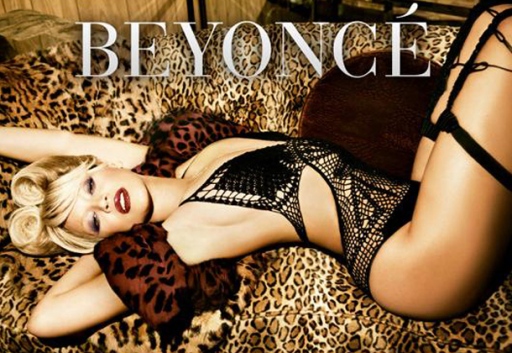
Consider this much bru-ha-ha-ed Beyoncé album cover featuring the blonde, almost unrecognizably pale singer. Now, it is unclear if Beyoncé (or her staff, producers, etc.) made this decision purposefully to have her appear lighter than she is in real life, or if this is due to the lighting used that day on set, or some other factor as yet unknown. However, similar critiques have been made of a L’Oreal campaign featuring the singer.

Why should we care? Certainly, Beyoncé has a right to portray herself any way she wants, and the woman is, without a doubt, stunning whatever her skin tone. Yet, as author Yasmin Alibhai-Brown said,

“Too many black and Asian children grow up understanding the sad truth that to have dark skin is to be somehow inferior… when black celebrities appear to deny their heritage by trying to make themselves look white, I despair for the youngsters who see those images.”

Similar to ideals of extreme thinness, the whitewashing of beauty standards affects women of color in significant ways. In addition, the charged nature of skin tone isn’t a U.S.-centric issue. In South Asia, where multinational companies are hopping on the skin whitening cream market, Bollywood actress, model and former Miss Universe Aishwarya Rai Bachchan is reportedly thinking of suing Elle Magazine for lightening her skin and hair in a cover shot.

To read the rest of this essay please visit Adios, Barbie

Monday, February 13, 2012

Can Feminists Dig Darcy?

Can feminists swoon for Jane Austen's quintissential romantic hero Mr. Darcy? Or does such an act require one to burn her membership card?

Similarly, can someone concerned with classism and class politics also adore Julian Fellowes' early 20th century miniseries Downton Abbey without feeling the need to "Occupy the BBC?"

How do those of us with deep commitments to progressive politics reconcile our tastes in film and books - if those tastes include things that are not (at least on first glance) progressive?

I ask all this because there seem to be a lot of us out there. Progressive activist folks who also read, say, a Georgette Heyer once in a while (not to by any means compare Miss Heyer, that writer of light hearted regency romances, to my beloved Miss Austen), or get twitter injuries while watching Mad Men or Downton Abbey. And I don't mean making commentary on how sexist or classist the characters on those shows might be, rather, nerding out on their costumes or the dowager countess' fantastic one liners like this terribly classist one I just tweeted yesterday:

"Don't be defeatist, dear... it's so middle class."

So how do we do this? Do we, as a progressive friend of mine recently suggested, give certain authors or shows a "pass" because they are from a certain period or written so well? Do we shut off our internal social critic? Do we, as Zeta Elliot has suggested, forget about a certain part of ourselves while we read about such dissimilar characters -- to the point that we don't even recognize this erasure of self? Consider the words of Elliot (as quoted on the bookslut blog),


"Because I so rarely saw black characters in books when I was a child, I learned to relate to protagonists who didn’t look like me -- but that doesn’t mean I couldn’t identify with their struggles, triumphs, etc. It did mean, however, that I started to erase aspects of myself when I read -- I couldn’t consciously be black and read a lot of those books because then I’d realize there was no place for me in that imaginary realm. I didn’t pretend to be white, I just didn’t acknowledge my own erasure from the scenes that delighted me so much."

Along a similar vein, I recently read this post on Reading in Color called "Is Jane Austen only for white people?" Now, although my family is from a (postcolonial) part of the world that adores Austen and pretty much all sorts of British literature, and I am personally an Austen addict, I think the question is a compelling one.

So, dear friends and readers, what are your thoughts? How do we reconcile progressive politics with a love of, say, Austen? Now, I don't mean to say that Austen is somehow anti-feminist; in fact, her novels are imbued with a deep sense of women's worlds and women's lives - but of course these are a certain kind of women's worlds and lives.

In the end, whatever the reason, my social politics and my love of Mr. Darcy seem to co-exist quite happily together. As deeply committed as I am to feminist or anti-ractist activism, I am still quite likely to swoon over the intricate folds of Mr. Darcy's cravat.

The only explanation I can come up with is that life is complex and we humans are perfectly capable of multiple, seemingly contradictory commitments and passions.

What do you think?

Tuesday, January 31, 2012

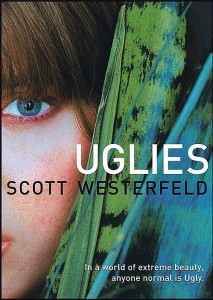
Are You an Ugly or a Pretty? Technology, Nature and Beauty in Scott Westerfeld's "Uglies"


What if everyone was beautiful? No, I don’t mean inner beauty, prettiness that shines from the inside out. I mean, wide eyes, perfect noses, proportionate bodies, and symmetrical faces. The same approximate height, weight, skin color? Could making everyone look the same even the social and economic playing fields?

But human variety is important—it would be boring for everyone to be conventionally pretty, you say.

Well, what if we upped the stakes? What if making everyone beautiful could help stop bullying or eliminate eating disorders? What if it eradicated racism, prejudice, or even brought an end to all war and conflict?

Would it be worth it then?

Young adult (YA) author Scott Westerfeld spins these possibilities, and more, into his novel Uglies. In so doing, he follows in the tradition of other science fiction/speculative fiction writers who use settings on different planets or in future dystopian Earths to examine sociopolitical problems in our present day lives. African American sci-fi legend Octavia Butler used many of her short stories and novels to examine race, gender, power, and slavery; similarly, The Handmaid’s Tale novelist Margaret Atwood imagined sexism taken to the extremes of reproductive terrorism in her novel—a world where women are literally reduced to being walking wombs.

In Uglies, Westerfeld seems to be undertaking a similar project but with body image politics. His novel is set in a futuristic world where everyone on their 16th birthday undergoes an extreme makeover, the super-duper plastic surgery edition. Until they have this bone-crunching, face-rearranging operation, teens are “uglies” and have to live in (the slightly unimaginatively named) “Uglytown” watching the glamorous post-surgical “pretties” across the river in high tech “New Prettytown” leading wonderful lives of (competition-less, racism-less, prejudice-less, aggression-less) happiness and endless partying.

In a sense, Westerfeld’s dystopian world is teen reality writ large—the feeling of being on the outside looking in, waiting for your life to start, wishing one could be ‘like everyone else.’ And in that sense, the novel is about learning to be ‘happy with oneself,’ and embracing one’s autonomy rather than following the herd.

At the beginning of the novel, Westerfeld’s 16-year-old protagonist, Tally, can’t wait to turn pretty. But when her new friend Shay runs away, she faces a serious choice: to either join her friend in a rag-tag community of people who have chosen to remain “ugly forever,” or turn in these rebels to the authorities in exchange for her coveted operation.

To read the rest of this essay, please visit Adios, Barbie

Thursday, January 19, 2012

Tina's Mouth: Shizz Brown Girls Say to Dead White Philosophers

So in light of that S*** Girls say to ... subversive meme that's been all over the interwebz lately (see this round up on Racialicious if you missed it or were having an extra-long cyber-blackout protesting SOPA or something), I was thinking that Keshni Kashyap's delightful Tina's Mouth  could potentially be subtitled "s*** brown girls say to dead white philosophers."

Actually called an "existential comic diary," the coming-of-age graphic has been compared to both Marjane Satrapi's Persepolis and Gene Luen Yang's American Born Chinese. In it, the titular Tina writes to the occularly challenged French philosopher Jean Paul Sartre ("I like your face and your wandering eye, which makes you seem as if you were looking in two directions at once.")  as part of a high school class in existentialism, and Mon Ami JP ends up bearing witness to the break up of her deep friendship with an ex-Mormon named Alex, her crush on a flakey skateboarder, her role in the school play (Kurosawa's Roshomon!), and her interactions with the Indian community (including an Auntie affectionately called "Hook-dat-S***-Up" Auntie for her "superhuman matchmaking abilities."), among other existential high school adventures.

I absolutely loved the book, and found myself laughing out loud at several points. And in part, that might have been why I loved it so much - what was the last book about an Indian American girl that was so laugh-out-loud funny? (there are a few, but should I really be able to count them on my fingers?)

The expectation seems to be that brown girl coming of age stories will be more angst-ridden, more sweeping and epic, more to do with Cultcha (with a capital C) than everyone else's coming of age stories (as the aforementioned meme might say "You're so, like, exotic. Like, jai ho, you know?") Tina's Mouth addresses race, racism, and immigrant community dynamics, yes, but with an equal dose of humor, intellect and wacky surreality.

The Hindu legend says that as a baby, the Lord Krisha was very naughty. As he was playing in the dirt one day, his mother saw him eating a good amount of soil. Now, she knew that -  whether blue skinned and divine or not - that couldn't be good for his tiny godly digestive track. But when his mother Yashoda went to scold him, and get that e-coli outa there, she was startled to find the entire universe inside her infant's mouth. Swirling planets, stars, galaxies within the body of a tiny babe.

So is explained (or perhaps made more confusing) many aspects of Hindu philosophy - the child as guru, the interchangeability of inner and outer space, the interconnections between of the universe and the individual, the mystery and ambiguity of life itself, the deep lessons in the every day, the presence of the divine in the mundane.

In Keshni Kashyap's new book, there are galaxies of insight - about race, about teenage life, about love and life and family and friendship and romance, and really bad high school theater - swirling around within the body of her fictional heroine's story. Both enlightening and off the hook hilarious, the book is simply divine.

Go on, Keshni, hook dat s*** up. Like, jai ho, y'all.

Friday, January 13, 2012

'Differences' as Superpowers in Middle Grade Novels

I have a confession to make. I fully intended this post to be about body image in middle grade novels. I had recently written about various issues of body image in YA novels, and, remembering fantastic MG books from my own childhood like Paula Danzinger’s The Cat Ate My Gymsuit and Judy Blume’s Blubber, I wanted to explore the many current day middle grade novels tackling the tricky issues of weight, disordered eating, body difference, and self image.
But I couldn’t find them.

I begged my brilliant fellow Mixed Up Files bloggers for suggestions and found this great site on body image in picture books as well as MG and YA novels. Although some of the middle grade titles suggested look fascinating (including Susan Shreve’s Jonah the Whale and Pamela Todd’s Pig and the Shrink), the truth is, most of the books we immediately thought of, including Allen Zadoff’s Food, Girls, and Other Things I Can’t Have, Robin Brande‘s Fat Cat, Erin Dionne‘s Models Don’t Eat Chocolate Cookies and Carolyn Mackler‘s The Earth, My Butt, and Other Big Round Things were actually young adult novels.

I kept searching, growing increasingly frustrated, until I stepped back and decided to re-examine my assumptions. Certainly, there are middle grade novels out there portraying characters with disabilities. Last year, I posted here at From the Mixed Up Files on the topic, and since then, have found several other fantastic book lists of disability in children’s literature, including this one at YA highway (MG novels included here).

But it occurred to me that while there are surely some middle grade books out there dealing with body image in the same realistic way as Danzinger or Blume (please feel free to share them below!), many are choosing to take difference (both within the realm of ‘different’ able bodies and disabilities) and put it on its head, such that kids’ ‘non-normative’ bodies, abilities, or conditions aren’t problems, but assets.

Consider Rick Riordan’s choice to have his protagonist Percy Jackson’s ADHD be a sign of his demi-god status. What’s called hyperactivity in modern life is in fact the quick reflexes required for battling gorgons and monsters. And Percy’s dyslexia? Why that’s of course because his brain is wired to read ancient Greek, not English. Even secondary characters in Riordan’s series have disabilities that in fact mask their superpowers. Percy’s wheelchair bound teacher is the mythical centaur warrior Chiron (whose special chair magically hides the fact he has the the lower body of a horse), and his best friend Grover’s leg braces and crutches mask the fact that he has goat’s fur and hooves, because he is a satyr.

Or consider Michael Buckley’s N.E.R.D.S (National Espionage, Rescue and Defense Society), in which braces and headgear, buck teeth, asthma and a tendency to eat paste all become secret weapons – the ability to walk on ceilings, for instance (the kid who eats paste, Agent Name: Gluestick) or fly around using an asthma inhaler and nebulizer (Agent Name: Wheezer). Similarly, Ross Venkur’s titular hero in The Autobiography of Meatball Finkelstein is an overweight, socially ostracized vegetarian who discovers that eating meatballs actually gives him superpowers.


To read the rest of this post, please go to From the Mixed Up Files of Middle Grade Authors!

Tuesday, January 10, 2012

Attack of the Humorless Feminists on Downton Abbey

Ok. Confession time.

I took this quiz to find out which Downton Abbey character I was most like, and, not that surprisingly I turned out to be Lady Sybil Crawley, youngest daughter of Lord and Lady Grantham. And since then I've been obsessing about her.

For those of you who are afficionados of the show, now in its second season here in the States (if you're not, check out this hilarious and naughty review), you know that Sybil is the earnest, socially conscious character, the most likely young aristocrat to get punched out at an election rally, as well as the most likely noble to marry the Irish socialist chauffeur, a character who (unlike her intermittently evil sisters) we all love to love. (On the first show of season 2, she's become a Florence Nightingale-like nurse, and learned to make her bed and bake a cake for her mum, for goodness sake!) And yet, she's also character with the least edges, the least three dimensionality, the least (gasp) humor.

Which makes me think - why do we always imagine feminists to be so darned humorless?

Along with the other socially conscious character on the show, cousin Isobel Crawley, Sybil is a sort of public moral compass - the person we're supposed to trust in regard to matters of truth, justice, and the American way (and by that, I mean, the toppling of the British class system). I know, I know, it's a British show, created by Britishers, set in England; but there's such a streak of earnest class critique (with an equal part of class romanticization) in Downton that it feels positively, well, Yankee. (for some interesting analysis of class on the show see this great article)

Isobel and Sybil are also the characters most likely to have subscribed to Ms. Magazine, or hung out with Gloria Steinem, had they lived in the right part of century. They're pro-women's vote (although not quite so radical as to actually go and do something about that), pro-getting your hands dirty, pro-flaring your nostrils and setting all manner of things to good and pure and right.

But do they really have to be so, well, un-funny? Some of my favorite feminists and social radicals are also really funny people. The humorless feminist is in fact such a common trope that modern feminists are often debating why it's used so often against us, and how to comment on sexist humor without getting slammed with it.

I love Downton Abbey, and while I know that it's a show that's already made, and Julian Fellows isn't reading my blog post and making script changes on the spot, I really wish Isobel and Sybil could chill out a little, take some risks that go beyond wearing ugly pants to dinner (or calling out butlers and footmen who have pretend lung conditions and can't go be cannon fodder in the war). Like maybe kissing the chauffeur guy when he declares his love to you, Sybil, while simultaneously stealing Matthew from under your witchy sister Mary's nose (hah! who's the radical feminist countess now?).  

Sybil's so earnest, sincere and sweet, she's starting to make my teeth ache. I still love her, mind you, but would just like to laugh with her a little too.


What's Up With the Super Skinny Demonic Pregnancy in "Breaking Dawn"?


If you have been, say, living in outer space, in some kind of a no-media cult, or simply in possession of particularly discriminating taste, and have not seen the Twilight films, or read Stephanie Meyer’s books, then, before you read this post, I respectfully send you to these superlative examples of feline scholarship otherwise known as the LOL cat reviews of the Twilight films.

For the rest of the population, read on.

A gender studies professor and a religious studies scholar went into a darkened movie theater earlier this fall and saw a film about pseudo-Mormon vampire families, oral demonic C-sections, and baby-werewolf imprinting. No, that’s not a joke, although by the time the film ended, my religious studies professor friend and I kind of wished it was, too. (Now, if you know about Twilight but haven’t seen Breaking Dawn (part 1), or have seen it, but blocked it out with a self-inflicted lobotomy – excellent choice btw, I respectfully send you to this naughty but oh-so-clevah summary of the movie at g4tv.)

Now, plenty has been written about the Mormon influences in the Twilight books, including the juxtaposition of the ‘white and delightsome’ sparkly vampire Cullen family with the indigenous “savage werewolves in need of vampire colonization.” (At the very least, that Jacob kid needs someone to buy him a shirt, already.) And there’s been an equal amount written about Bella as swooning anti-feminist heroine, whose ‘choices’ are more often than not the ‘choice’ to be passive and, um, whiney. (As the LOL cats would say, “Uh-oh. my only raison for to lives, gones. *Mope so sad. I jes stare out windo for thfree monz.”)

Now that Breaking Dawn (parte uno) has finally brought the clumsy but deliciously ensangrinated human Bella (that’s like, something European for ‘beautiful’, did you know that?) and breathtakingly glowy vampire dude Edward (a 107-year-old un-dead guy as your high school biology lab partner, no that’s not creepy at all) to the altar, nuptial bed, and super-disturbing at-home baby delivery table, there has been some wonderful feminist analyses of the essentially anti-choice ‘choice’ rhetoric peppered through the film.

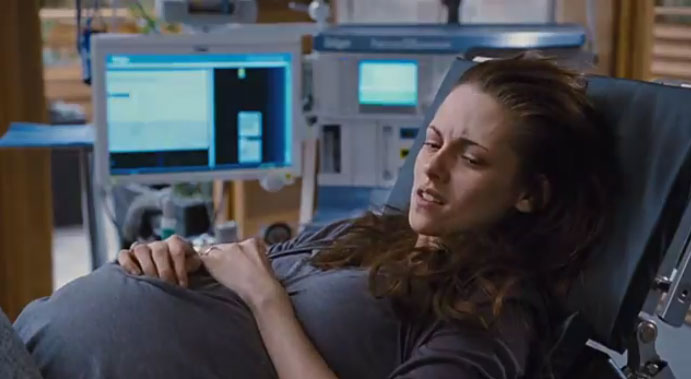
After Bella gets pregnant (‘natch) like the second she says, “I do,” she embraces the “choice” to give birth to her demon spawn – despite Edward, Alice, and every other thinking person in the audience’s urgings to have an abortion. In fact, she employs grumpy blonde Cullen sister Rosalie to serve as a sort of anti-abortion protester cum bodyguard – protecting Bella’s rapidly swelling body from the (sensible) pro-choice machinations of, um, everybody else. Despite looking like she’s a hunger striker with a strapped on baby bump that she stole from the dressing room of “A Pea in the Pod,” Bella is determined to play the dutiful mother-to-be who “loves” her fetal monstrosity far more than herself (even when that love involves delicately sipping human blood through a non-environmentally friendly Styrofoam cup + straw).

Now, the grotesque pregnancy and birth scenes in Breaking Dawn are consistent with recent cultural obsessions with horrible images of pregnancy and birth on television.  Bella’s bun is also consistent with historical notions of “monstrous pregnancies” caused by overworkings of the maternal imagination, as well as the “pregnancy/birth pornography” indulged in by many recent dramas about historical figures. In the words of Bitch Magazine blogger Katherine Don:

For the rest of this blog entry, please go to Adios, Barbie!