Saturday, December 10, 2011

What Makes a Good Read-Aloud?


I try to read to my children every night. Even though they like to read themselves. And I think I'll keep doing it until they are in college - if they let me.

I was inspired to continue reading aloud to my kids far beyond those toddler years primarily after reading this fantastic New York Times article about a father and daughter who read aloud together every day until she was in college. They called it "The Streak" (because they never missed a day, not for prom, not for parties, not for the father being out of town), and the process gave them a common language, a shared way of imagining the world, and in many ways, it became the glue that held their family together through troubled times.

My fellow pediatrician and writer Perri Klass, the creator of the now national Reach Out and Read Program (a program in which pediatricians give out age- and language-appropriate books to young families at each and every well child visit and write "presciptions for reading") has talked about the benefits of reading aloud for both children and parents. In her words, "Families that make a habit of reading aloud create a habit of slowing down and lovingly interacting that is as good for parents as it is for children...In times of crisis...parents can use books and reading aloud to maintain routines and reassure children.”

A couple of months ago, I learned this first hand, when I had to make an unexpected emergency room visit with my 7yo daughter. A coffee table had unexpectedly attacked her eyebrow (OK, yes, she fell off a chair, and she's fine now, thanks to the miracles of dermabond "skin glue"). Needless to say, there was at first a lot of blood, and a lot of screaming. Worried about an interminable ER visit, I grabbed one of Gail Carson Levine's Fairy Haven books as we walked out the door. My daughter had calmed down a bit, but started whimpering in a heart-wrenching, terrified way when we got to the hospital. As the nurse settled us behind the curtain, I curled up next to her on the examination table and began reading. It was like magic. I felt her body immediately relax into mine as her mind drifted away on my voice, the images my words were making. Her 9yo brother, who had come along, and was pretty terrified too, relaxed and smiled and made jokes when we got to the funny parts of the book. I think it won us points with the nurse as well. She definitely looked a little misty eyed when she came in and found us immersed in storytime, as if the sterile, cold hospital room were one of our bedrooms at home.

But what I've discovered, in fact, is that not all read-alouds are alike. I adored George MacDonald's children's books as a child, but a recent attempt to read The Princess and the Goblin was a big bust. To their credit, the kids loved the story while we were reading it -- the language is glorious and the happenings magical. Yet, perhaps because of the slower pace of the book, none of us were particularly inspired to pick it up again night after night. Unlike the books they read on their own (and can read incessantly: while brushing teeth, while in the car, semi-secretly at night, etc.), a read aloud has to be interesting enough to pick up every night after having been put down for 24 hours. 

For us, good read-alouds also need good character voices. I was recently bemused to hear my daughter - while arguing with her brother - say "That's just rubbish!" in an approximation of the refined (fake) British accent I use for Hermione while reading Harry Potter. 

 In fact, I'm realizing those elements of "reader's theater" (distinguished voices, action, exciting plot) are what make the difference between exciting and so-so read-alouds. They certainly make a difference even to those books I hear on CD in the car. I've recently been listening to the Leviathan series by Scott Westerfeld, narrated by Alan Cumming and his delicious Scottish brogue. (check out a sample here) The story is compelling and fun, yes, but Cumming's reading has made the book come alive for me. I can't wait to have his accents narrate my previously stressful commutes home.

I know slow and beautiful Newberry winner type books are supposed to be ideal for read-alouds. But I guess what I've realized, at least in our family, is that we prefer to read those sorts of books on our own - it's the many voices, and fun pace of action series that keep our attention during evening read-alouds (not to say that Newberry winners aren't sometimes fun and fast as well, but you know what I mean...).

What sorts of books are your favorite read-alouds?


Tuesday, November 22, 2011

When Did My Tampon Become a Fortune Cookie?

Apparently, when I wasn’t looking, some corporate geniuses decided that tampons should come packaged with perky self-help style advice. I can see the business meeting now: “Hey, I know what a menstruating girl or woman might need at ‘that time of the month’ alongside product absorbency! How about some inspiration!”

And so, this morning’s plastic tampon wrapper (I know, I know, I should be using a non-plastic brand, or a diva cup but go with me here) nearly shouted at me with the rah-rah force of a pom-pom wielding cheerleader:

“Don’t Stress!” “Play to Win!” and, worst of all, “You’re a take-charge kind of girl!” it shrieked.
I don’t know about you, but I’m willing to take pseudo-Eastern sounding mysticism from the tag of my tea bag, but I draw the line at inspiring tampon covers.
So, I guess my real question is this: When did girl power go amok?

I just came back from the National Women’s Studies Association conference, where there were lots of interesting panels on girl’s movements and girlhood related politics. Some panel names were:
  • Hey Shorty! Young Women of Color Take Research Out of the Academy
  • The Sexualization of Girls Across Time, Space and Cultural Mediums
  • Today, Not Someday When We’re Grown: How Girls ‘Do’ Activism
  • Representing Girlhood and Girls of Color, From Hip-Hop to Health
Awesome, right? (I wish I could have attended them all!)

Girl’s activism is a real and formidable force in the U.S. and around the world. But in broader culture, “girl power” has become heavily usurped–a snazzy marketing ploy by corporate forces who want to appeal to women and girl’s pocketbooks, not our politics. I know there’s been a lot of attention to steering women and girls away from passive “pink” marketing like books from Packaging Girlhood: Rescuing Our Daughters from Marketers Schemes to Cinderella Ate My Daughter: Dispatches from the Front Lines of New Girlie-Girl Culture. But what about the taking over of “girl power” for marketing ends?

Consider the controversial Gardasil “One Less” commercials, featuring seemingly empowered, soccer playing girls also choosing to get vaccinated against HPV. (So… all girls who are empowered will get the HPV vaccine? Or alternately, get the HPV vaccine and become empowered?) Or, how about the Dove Clinical Protection deodorant ads in which a young woman cuts her own bangs with nail scissors (ooh, rebellious!) before deciding she will “Carpe Diem” today. Or, even the “Be Unstoppable” ads for Playtex Sports Tampons, which seem to shout (at least in my head), “Wear our tampons! Become a champion surfer!”

To read the rest of this post, please go here!

Saturday, October 15, 2011

Novel as Mirror: Teen Literature and Body Image


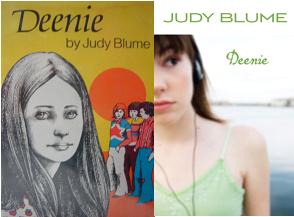
 The first young adult (YA) novel I ever read that had to do with body image was Judy Blume’s Deenie (1973). In it, 13-year-old Wilmadeen “Deenie” is the “pretty one” of the family, the one whose mother dreams will be a model someday. When Deenie is diagnosed with scoliosis and required to wear a back brace, she struggles with self-image and self-acceptance—worrying that her crush won’t find her attractive, that she will be an object of social ridicule at school, and that she won’t ever get to be a model. Instead, Deenie negotiates a new sense of self, new relationships with her parents and sister, new friendships, and contemplates a career as an orthopedist, realizing that perhaps she never wanted to be a model after all.

For its explicit mentions of masturbation and menstruation, Deenie is one of the most frequently challenged and banned books of all time. But its real radicalism is as an early example of how teen literature can tackle critical issues including body image and body self-acceptance. In other novels, including Blubber (1974) and Are You There, God? It’s Me, Margaret (1970), Blume similarly tells young women’s coming of age stories, and of the accompanying social and environmental pressures therein. (However, in Blume’s Forever (1975), a novel about the first sexual experience, her portrayal of the ultra-thin protagonist is left unexamined, which is soundly critiqued by Beth Younger in her book Learning Curves: Body Image and Female Sexuality in Young Adult Literature.)

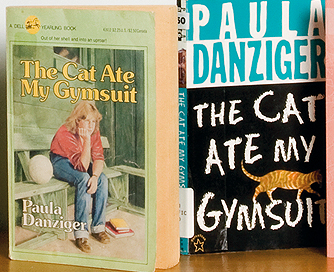
Also published in the same era, Paula Danzinger’s The Cat Ate My Gymsuit (1974) similarly addressed issues of self-image, this time through the point of view of 13-year-old Marcy Lewis, a self-described “baby blimp with wire frame glasses and mousy brown hair.” However, Marcy is more than simply “fat” and her personal growth is vis-à-vis more than just body self-acceptance. As Marcy evolves, she ends up being an activist for change in the small community of her school.

An entire group of current-day YA literature tackles issues of body image, similarly generating controversy. For example, author Laurie Halsie Anderson’s novel Wintergirls (2009), which is written from the point of view of a young woman with severely disordered eating, has caused great uproar among parents and educators.

To read the rest of this essay, please go to Adios, Barbie!

Tuesday, October 11, 2011

Writing as Yoga: From Plot to Padmasana

I've long realized the connections between writing and the practice of yoga - the meditative inward looking, the humility and reception, the striving for greater personal and universal understanding.


But it was only recently that the connections between the teaching of writing and yoga revealed themselves, as it were, to my consciousness.


My favorite teachers of yoga usually begin their classes with a dharma talk. This is a time for the instructor to read from a yogic or other Hindu spiritual text, to discuss a particular issue regarding asana or life with which they have been struggling. In this way, the teacher makes clear that they too are a student, and that there is no hierarchy in the seeking of true knowlege. Flexibility, humility, breath - the best teachers draw attention to some aspect of yoga and make the connection between that practice and its significance in our lives beyond the mat. You get to practice these challenging aspects of selfhood in the safety of the mat, one of my favorite teachers would say, and when you don't get it right, you can return to the mat and practice again.


Without realizing it, I've found myself beginning my new fiction writing class this semester with something like a dharma talk. I might draw attention to some aspect of craft - plot, character, dialogue, setting - but more importantly, some aspect of the writing life with which I have been grappling - humility, wonder, process over product, inspiration. Often, I'll read from a blog entry, poem, or short story that came across my desk that week that gave me deeper insight into the issue at hand.


One week, early on, when many students seemed too intimidated to write - under the false impression that the work of FICTION was something somber and terrifying, I passed out and had them read aloud passages from Lorrie Moore's delightful How to Become a Writer in which she urges:

First, try to be something, anything, else.  A movie star/astronaut.  A movie star missionary.  A movie star/kindergarten teacher.  President of the World.  Fail miserably.  It is best if you fail at an early age -- say, fourteen.  Early, critical disillusionment is necessary so that at fifteen you can write long haiku sequences about thwarted desire.


The following week, when multiple students were experimenting with writing from ethnic, disability or gendered points of view not their own, I passed out Mitali Bose Perkins' recent blog posting on Writing Fiction without the "Right" Ethnic Credentials. In Mitali's words,
Fiction, lest it morph into memoir, always involves the crossing of borders. We create characters who belong to different classes, genders, and generations.

Yet, on empathy, she writes,

If a particular community is processing a shared experience of suffering through the healing power of story, maybe it's time for our "outsider" version to wait. When we have more power in society than our protagonist, it's always good to ask whether to speak on his or her behalf. If we still feel compelled by the story, we must lean heavily on the gift of imaginative empathy...Someone once said that to cross a border of power to tell a story, a writer better live there first, shut up, and hold a bunch of babies.


Finally, one recent week when I was struggling myself with finding the humility and wonder necessary to teach, and write, fiction, the most wonderful Olugbemisola Rhuday-Perkovich pointed me in the direction of this blog posting by Peter Turchi on "The Virtues of Obsession: Where We Dwell."
In it, Turchi turns to Emily Dickinson, who wrote, 

I dwell in Possibility 
A fairer House than Prose 
More numerous of Windows 
Superior for Doors 

I immediately wrote that passage on the blackboard. Yes, I thought, possibility - that is where my students and I dwell - that liminal, in-between space - that doorway into every single room you can imagine - that place of infinite possibilities rather than fixed products.

Turchi ends his insightful post with T.S. Eliot, who brought me to my knees. Yes, I thought, writing must go via the scary place, the humble place, the way of ignorance, the way of dispossession. To find who we are as writers, as people, to find who we simply ARE, we must go the way in which we are not. It is only through embracing the darkness of that which we do not know that we can arrive at the flickering light of self-knowledge:


You say I am repeating
Something I have said before. I shall say it again.
Shall I say it again? In order to arrive there,
To arrive where you are, to get from where you are not,
You must go by a way wherein there is no ecstasy.
In order to arrive at what you do not know
You must go by a way which is the way of ignorance.
In order to possess what you do not possess
You must go by the way of dispossession.
In order to arrive at what you are not
You must go through the way in which you are not.
And what you do not know is the only thing you know...