Saturday, October 15, 2011

Novel as Mirror: Teen Literature and Body Image


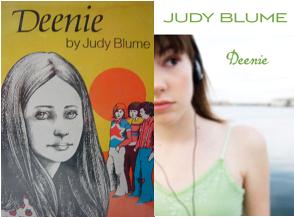
 The first young adult (YA) novel I ever read that had to do with body image was Judy Blume’s Deenie (1973). In it, 13-year-old Wilmadeen “Deenie” is the “pretty one” of the family, the one whose mother dreams will be a model someday. When Deenie is diagnosed with scoliosis and required to wear a back brace, she struggles with self-image and self-acceptance—worrying that her crush won’t find her attractive, that she will be an object of social ridicule at school, and that she won’t ever get to be a model. Instead, Deenie negotiates a new sense of self, new relationships with her parents and sister, new friendships, and contemplates a career as an orthopedist, realizing that perhaps she never wanted to be a model after all.

For its explicit mentions of masturbation and menstruation, Deenie is one of the most frequently challenged and banned books of all time. But its real radicalism is as an early example of how teen literature can tackle critical issues including body image and body self-acceptance. In other novels, including Blubber (1974) and Are You There, God? It’s Me, Margaret (1970), Blume similarly tells young women’s coming of age stories, and of the accompanying social and environmental pressures therein. (However, in Blume’s Forever (1975), a novel about the first sexual experience, her portrayal of the ultra-thin protagonist is left unexamined, which is soundly critiqued by Beth Younger in her book Learning Curves: Body Image and Female Sexuality in Young Adult Literature.)
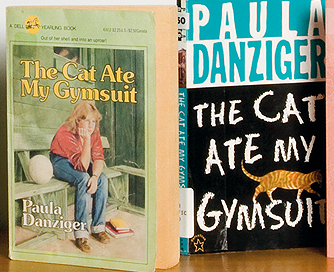
Also published in the same era, Paula Danzinger’s The Cat Ate My Gymsuit (1974) similarly addressed issues of self-image, this time through the point of view of 13-year-old Marcy Lewis, a self-described “baby blimp with wire frame glasses and mousy brown hair.” However, Marcy is more than simply “fat” and her personal growth is vis-à-vis more than just body self-acceptance. As Marcy evolves, she ends up being an activist for change in the small community of her school.

An entire group of current-day YA literature tackles issues of body image, similarly generating controversy. For example, author Laurie Halsie Anderson’s novel Wintergirls (2009), which is written from the point of view of a young woman with severely disordered eating, has caused great uproar among parents and educators.

To read the rest of this essay, please go to Adios, Barbie!

Tuesday, October 11, 2011

Writing as Yoga: From Plot to Padmasana

I've long realized the connections between writing and the practice of yoga - the meditative inward looking, the humility and reception, the striving for greater personal and universal understanding.


But it was only recently that the connections between the teaching of writing and yoga revealed themselves, as it were, to my consciousness.


My favorite teachers of yoga usually begin their classes with a dharma talk. This is a time for the instructor to read from a yogic or other Hindu spiritual text, to discuss a particular issue regarding asana or life with which they have been struggling. In this way, the teacher makes clear that they too are a student, and that there is no hierarchy in the seeking of true knowlege. Flexibility, humility, breath - the best teachers draw attention to some aspect of yoga and make the connection between that practice and its significance in our lives beyond the mat. You get to practice these challenging aspects of selfhood in the safety of the mat, one of my favorite teachers would say, and when you don't get it right, you can return to the mat and practice again.


Without realizing it, I've found myself beginning my new fiction writing class this semester with something like a dharma talk. I might draw attention to some aspect of craft - plot, character, dialogue, setting - but more importantly, some aspect of the writing life with which I have been grappling - humility, wonder, process over product, inspiration. Often, I'll read from a blog entry, poem, or short story that came across my desk that week that gave me deeper insight into the issue at hand.


One week, early on, when many students seemed too intimidated to write - under the false impression that the work of FICTION was something somber and terrifying, I passed out and had them read aloud passages from Lorrie Moore's delightful How to Become a Writer in which she urges:

First, try to be something, anything, else.  A movie star/astronaut.  A movie star missionary.  A movie star/kindergarten teacher.  President of the World.  Fail miserably.  It is best if you fail at an early age -- say, fourteen.  Early, critical disillusionment is necessary so that at fifteen you can write long haiku sequences about thwarted desire.


The following week, when multiple students were experimenting with writing from ethnic, disability or gendered points of view not their own, I passed out Mitali Bose Perkins' recent blog posting on Writing Fiction without the "Right" Ethnic Credentials. In Mitali's words,
Fiction, lest it morph into memoir, always involves the crossing of borders. We create characters who belong to different classes, genders, and generations.

Yet, on empathy, she writes,

If a particular community is processing a shared experience of suffering through the healing power of story, maybe it's time for our "outsider" version to wait. When we have more power in society than our protagonist, it's always good to ask whether to speak on his or her behalf. If we still feel compelled by the story, we must lean heavily on the gift of imaginative empathy...Someone once said that to cross a border of power to tell a story, a writer better live there first, shut up, and hold a bunch of babies.


Finally, one recent week when I was struggling myself with finding the humility and wonder necessary to teach, and write, fiction, the most wonderful Olugbemisola Rhuday-Perkovich pointed me in the direction of this blog posting by Peter Turchi on "The Virtues of Obsession: Where We Dwell."
In it, Turchi turns to Emily Dickinson, who wrote, 

I dwell in Possibility 
A fairer House than Prose 
More numerous of Windows 
Superior for Doors 

I immediately wrote that passage on the blackboard. Yes, I thought, possibility - that is where my students and I dwell - that liminal, in-between space - that doorway into every single room you can imagine - that place of infinite possibilities rather than fixed products.

Turchi ends his insightful post with T.S. Eliot, who brought me to my knees. Yes, I thought, writing must go via the scary place, the humble place, the way of ignorance, the way of dispossession. To find who we are as writers, as people, to find who we simply ARE, we must go the way in which we are not. It is only through embracing the darkness of that which we do not know that we can arrive at the flickering light of self-knowledge:


You say I am repeating
Something I have said before. I shall say it again.
Shall I say it again? In order to arrive there,
To arrive where you are, to get from where you are not,
You must go by a way wherein there is no ecstasy.
In order to arrive at what you do not know
You must go by a way which is the way of ignorance.
In order to possess what you do not possess
You must go by the way of dispossession.
In order to arrive at what you are not
You must go through the way in which you are not.
And what you do not know is the only thing you know...


Monday, September 19, 2011

Faster, Author! Faster! Write like the wind!

This morning, I read this fascinating piece in the New York Times suggesting that authors write faster. Well, it actually suggested that authors who take the, say, "decade or more in between great novels" approach to writing (ahem, Jeffrey Eugenides) have less cultural capital as it were than a great, if somewhat more prolific novelist (say, Saul Bellow).  We as a culture go to and count on those whose novels reach our shelves more frequently, according to this article.

Of course, we can argue that certain writers, like certain novels, simply take more time. But this essay doesn't suggest that War and Peace should have been jotted off as a blog entry. What it does suggest that there is some amount of time that is a potential falling off point - a point where readers might look up and say "oh, I wondered what happened to him/her!" And perhaps not care. (Although I can't image that happening to Eugenides, whose Virgin Suicides and Middlesex were so breathtaking?)

But what does this all mean for the writer, or the writing student? Should we write faster?

My answer is, in short, yes.

"Writing faster" is something that actually works for me, and it's something I tell my fiction students to do as well. To clarify, what I mean by "writing faster" has less to do with the rapidity of releasing Nobel-Prize winning novels (neither I nor my students are claiming to be Bellow or Eugenides here), but rather, the time in which we produce our craft. 

Examples of "writing faster" I give to my students include: (1) freewriting with a kitchen clock/iphone timer set to 2-5 minutes (2) entering a contest aimed at producing word counts and volume like nanowrimo (3) giving yourself deadlines organized around writing groups, contests, calls for submission, and conferences.
"Writing faster," in these ways, is a means to shut down that pesky, evil internal editor who stymies our creativity and imagination before they even take root on the page. It is a way to circumvent those voices of doubt ("can I do it?"), the demands of day to day life ("but the laundry waits!"), and those annoying problems of plot and logic that have arrested many a first draft. 

"Writing faster" doesn't, however, mean editing faster. Or taking short cuts in our final product. What it does mean is permission to give form to all those fabulous, whimsical middle-of-the-night ideas on the page, to take risks, to push yourself and your writing to unknown places. To be afraid. To fall down. To grow.

So write like the wind, fellow novelists. Editing, like laundry, (and like Nobel Prizes), can come later.